
Understanding pain
How it works and what you can do beyond medication.
GLA:D® Osteoarthritis Treatment Programme in Christchurch
Evidence-based help for hip and knee osteoarthritis at You First Physio Avonhead and Longhurst.
If you're living with hip or knee osteoarthritis (OA) this is where you should start. It’s a best-practice, non-surgical approach that research shows is highly effective at improving quality of life and activity levels.
You First Physio were the first clinic in Canterbury to offer the internationally recognised GLA:D® programme. Our directors Cate Broderick and Katherine Pierce are both certified to teach GLA:D® and train other physiotherapists throughout Aotearoa/New Zealand.

Hip and knee osteoarthritis has a way of quietly narrowing your world.
The ache that's there when you wake up. The stairs you think twice about now. The walk you've cut shorter, the sport you've stepped back from, not because anyone told you to, but because it just seems easier that way.
If you've been told you have osteoarthritis of the hip or knee, you may have left that appointment wondering what your options are. Too often, the conversation jumps quickly to medication, or a waiting list for surgery. But for most people, there is a well-evidenced, lower-risk place to start that's not surgery.
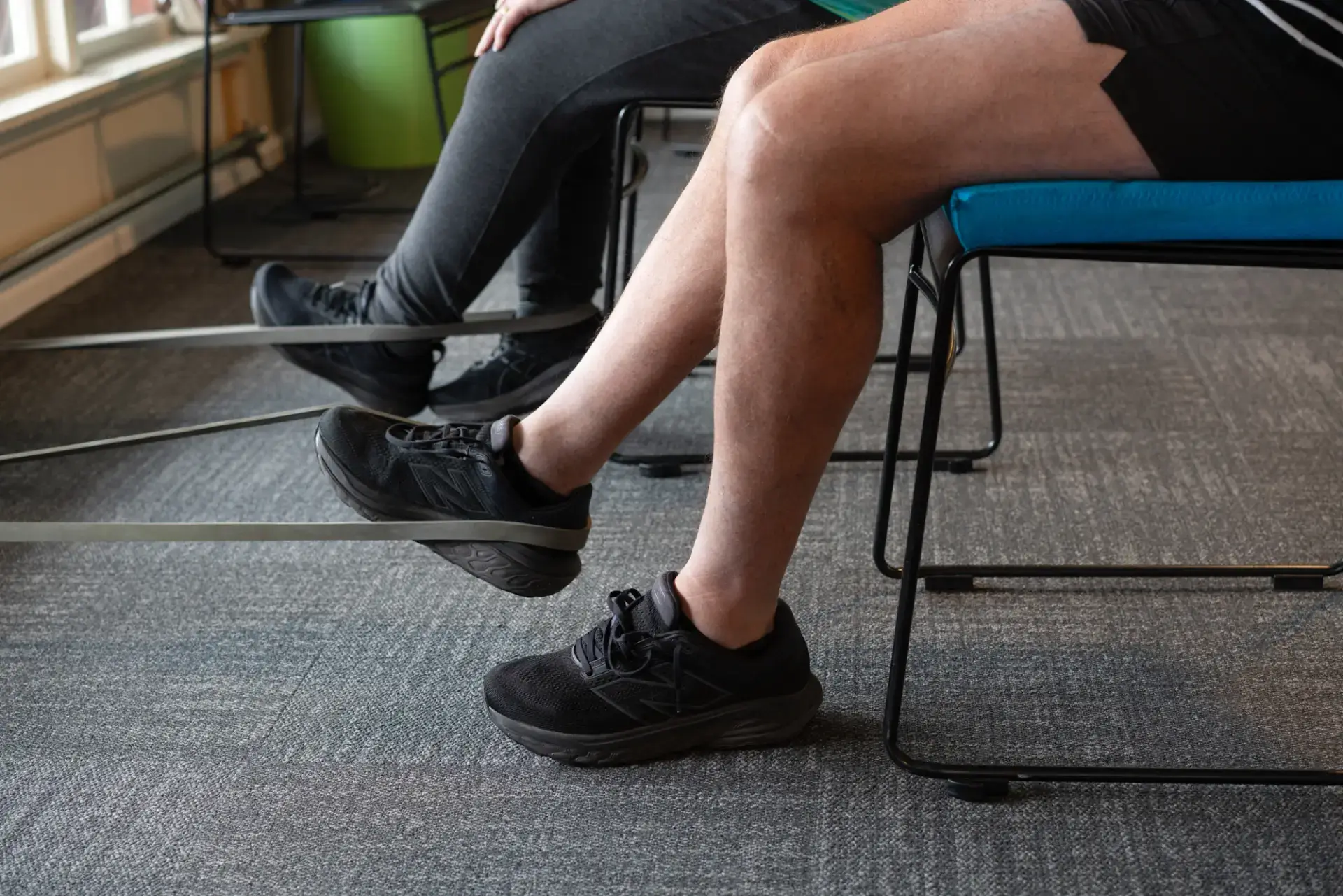
What is GLA:D® and how can it help?
GLA:D® (Good Life with osteoArthritis: in Denmark) is an internationally recognised programme developed by researchers in Denmark. It focuses on 3 key components: education, targeted exercise and decreasing inflammation and reflects the latest evidence in osteoarthritis research, incorporating real-world feedback from both patients and clinicians on what actually works.
Before medication or surgery is considered, current national and international clinical guidelines recommend education and exercise as the first-line treatment for osteoarthritis. GLA:D® is designed to deliver exactly that, in a structured, professionally supervised programme.
GLA:D® may be helpful for people at any stage of their OA journey, from first diagnosis through to preparation for, or recovery from, joint replacement surgery.
What GLA:D® research shows:
- Research from the GLA:D® programme in Denmark found symptom progression reduces by 32%
- Participants report less pain and reduced use of joint-related pain medication
- Fewer participants on sick leave at 12 months
- High participant satisfaction and increased physical activity levels at 12 months
- The programme is equally effective for people with mild and severe OA
Who can take part?
GLA:D® is designed for any person experiencing hip or knee osteoarthritis symptoms, regardless of severity. This should ALWAYS be explored before surgical options are sought.

This programme may be right for you if:
- You have been diagnosed with, or are experiencing symptoms of, hip or knee osteoarthritis
- Pain or stiffness is limiting your daily activities, work, or exercise
- You’ve been told you may need a joint replacement and want to understand all your options first
- You’re preparing for, or have recently had, a hip or knee replacement
- You’d rather have a structured, supported approach than manage alone
Not sure whether GLA:D® is right for you? Call us, your initial assessment will clarify this, and there’s no obligation to proceed.
A complete programme, not just exercise classes
Initial assessment
Functional baseline data collected; programme explained
12 exercise sessions
Twice a week for six weeks; maximum 6 per class
2 education sessions
Compulsory; provides an introduction to osteoarthritis and then an “exercise as medicine” session
4 voluntary external talks
Available at Longhurst
(see note below)
(see note below)
3-month follow-up assessment
Included; tracks your progress against baseline
1-year follow-up assessment
Included; long-term progress review
Your three-month and one-year follow-up assessments are a distinctive feature of GLA:D®. These give you and your physiotherapist a clear, evidence-based picture of how the programme is working for you, measured against where you started.

The Longhurst extended programme
At our Longhurst clinic, participants can also attend four voluntary external talks that explore:
Nutrition and joint health
How eating well can help relieve osteoarthritis symptoms and enhance overall wellbeing.
The surgical pathway
An honest, evidence-based look at what surgery can and cannot offer.
Podiatry
Choosing appropriate footwear and how podiatry might assist with alleviating osteoarthritis symptoms.
What it costs to join the programme
One $550 all-inclusive fee covers everything listed above.
No GP referral needed. Classes are held in small groups of no more than six participants.
Questions about cost before committing? Call us — we're happy to talk it through.
How to get started

An initial assessment with a GLA:D-trained physiotherapist is required before joining any class. Online booking is not available for this service.
Avonhead
03 358 8889Longhurst
03 595 0050Your GLA:D-trained physiotherapist will assess your hip or knee, collect functional baseline data, and explain how the programme works. You'll also discuss your goals — what you want to get back to — and confirm that GLA:D® is the right fit for your situation.
Small group sessions — a maximum of six participants — led by a GLA:D-certified physiotherapist. Sessions are designed to improve muscle control of the joint, build everyday strength, and correct movement patterns. If you need to miss a session, your physiotherapist will help you rebook. You don't need to complete them consecutively.
Alongside your exercise sessions, you'll attend two structured education sessions that deepen your understanding of osteoarthritis and how the GLA:D® exercises support lasting joint stability.
Both are included in your programme fee. These appointments measure your progress against the functional data collected at your initial assessment, giving you tangible evidence of how the programme has worked for you.
Many participants continue with our SUPER GLA:D® programme — a maintenance and continuation option designed for people who've completed GLA:D® or who are recovering from joint replacement surgery. Ask reception about availability when you book.
What our patients say
Excellent experience
Maggie McInnes is incredibly knowledgeable and passionate about her mahi but most importantly she is driven by empathy and kindness. You never feel rushed or dismissed in her appointments.
Tori Holden
Exceptionally skilled and caring
They are exceptionally skilled and caring and show genuine warmth and empathy and client care. I would never go anywhere else.
Veresha Padayachee
Very Professional service
Saw Jack today. He got to the bottom of my wrist issue right away. Told me what was causing the issue and how to fix it.
Lewis Cashell
GLA:D Osteoarthritis FAQs

Everyone starts with a 1:1 initial assessment before joining a GLA:D® class. This ensures the programme is clinically appropriate for your specific situation and gives your physiotherapist the baseline data they need to track your progress throughout. Please call us to get started.
No. You can self-refer directly to us, just call your nearest clinic to book your initial assessment.
Yes. GLA:D® is specifically designed to be adaptable across all stages of OA, mild through to significant joint changes. Your physiotherapist will confirm suitability and tailor the approach at your initial assessment.
Your physiotherapist can help you rebook missed sessions. The programme doesn't need to be completed consecutively. If life gets in the way, we'll work around it.
Yes, this is exactly what the programme is designed for. GLA:D® research shows it may help delay or reduce the need for surgery, and for those who do proceed to surgery, it provides documented pre-operative preparation. Discuss your specific situation with your physiotherapist at your initial assessment.
Post-operative recovery is another situation where supervised exercise and education may be helpful. Ask us about SUPER GLA:D®, a continuation programme designed for people who've completed GLA:D® or are in recovery following joint surgery.
SUPER GLA:D® is a follow-on programme for people who've completed GLA:D® or who have had hip or knee replacement surgery. It builds on the foundations of GLA:D® to support ongoing strength and self-management. Call us to ask about availability and how to get started.
MAP (Mobility Action Programme) is a separate, CDHB-funded community programme for people with osteoarthritis. It has a different format from GLA:D® but may be beneficial for eligible patients. Ask our team when you call whether MAP may be suitable for you.
The 12 exercise sessions run twice a week over six weeks. Alongside this, you'll attend two education sessions. Your 3-month and 1-year follow-up assessments are scheduled afterwards and are included in your programme fee.
No, ACC does not cover treatment for the GLA:D programme due to osteoarthritis not being an accident related injury.
Symptoms usually develop slowly over many years, and the severity can range from mild to significant. How it progresses varies from person to person. Common symptoms include:
- Joint stiffness in the morning or after exercise, usually subsiding within 30 minutes
- Swelling in or near the affected joint
- Muscle weakness around the joint
- A creaking or cracking sensation with movement
- Reduced flexibility and range of motion
- A lack of trust or confidence in the affected joint
Ready to take the first step?
GLA:D® starts with a single phone call. We'll answer your questions, confirm the programme is right for you, and book your initial assessment
Avonhead
03 358 8889Longhurst
03 595 0050$550 all-inclusive. No GP referral needed. Morning, afternoon and evening class times available.
Not ready for a call yet but have more questions? Drop us a line.
