
Pelvic Health (ACC covered)
Initial pelvic health ACC assessment
60 minutes$148 (Regular)
$140 (Concession)
Follow-up pelvic health ACC appointment
30 minutes$53 (Regular)
$45 (Concession)
Individualised care for pelvic health, for women and men at every stage of life.
Bladder leakage. Pelvic pain. Prolapse. Postnatal recovery. Pregnancy-related discomfort. Bowel concerns. Changes through menopause. Many of the things our team works with every day are things people hesitate to bring up, even with their own GP.
Our dedicated pelvic health physiotherapists provide exceptional, evidence-based care in a warm, private, and non-judgemental environment. You don't need a referral to book, and you don't need to be certain your concern is serious enough, that's exactly what your initial assessment is for.

One in three women will experience urinary incontinence at some stage in their lives. Around one in five will experience some form of pelvic pain. Pelvic organ prolapse affects a significant proportion of women who have given birth. And yet these remain among the least-discussed health concerns. They are often managed in silence, put down to ageing, or assumed to be something you simply have to live with.
You don't.

Pelvic floor physiotherapy is widely recommended as a first-line approach for many pelvic health presentations affecting women — from pregnancy and postnatal recovery through to peri- and post-menopause
Our dedicated women’s health team works alongside GPs, gynaecologists, midwives, psychologists, and other health professionals to ensure you receive co-ordinated, comprehensive care.
Common presentations we work with:

Pelvic health concerns are not exclusive to women, and our team also includes specialist expertise in male pelvic health. Jess Kydd-Coutts has specific training and clinical experience working with male patients, including time leading NHS pelvic health services in the UK.
Men are seen for a range of presentations, including:
If you're a man dealing with any of these concerns, you're in the right place. No referral needed, you can book directly with Jess.
Available at our Riccarton Clinic
Pelvic health physiotherapy may be helpful for a wide range of conditions and concerns, including:

Bladder leakage can take a number of forms. Leaking with coughing, sneezing, laughing, running, or jumping is known as stress urinary incontinence. Leaking associated with a sudden, strong urge to go is known as urge incontinence. Many people experience both. Bladder frequency (when you always need to know where the nearest toilet is) is another common presentation.
Physiotherapy is recommended as a first-line approach for these concerns.
Pregnancy brings significant physical change. Pelvic health physiotherapy during pregnancy may be helpful for pelvic girdle pain and lower back pain, bladder leakage, and musculoskeletal injuries during pregnancy.
We can also provide guidance around safe exercise, and help prepare your body for birth, including birthing positions and perineal massage. Support garments (belts, maternity tubi-grip) are also available where helpful.
Every postnatal recovery is different, which is why we take time to listen to your birth story and understand what you want to get back to.
Pelvic health assessments are recommended from six weeks onwards, and may assist with pelvic floor recovery, abdominal separation (diastasis recti), and a gradual return to exercise and sport.
ACC provides funding for physiotherapy treatment for a range of injuries that can occur during childbirth. This applies to eligible maternal birth injuries sustained on or after 1 October 2022.
Examples of injuries that may be covered include:
If you experienced a maternal birth injury from October 2022 onwards, we can lodge your ACC claim directly. You do not need to see your GP first.
Please note that ACC does not currently provide cover for episiotomies or caesarean sections.
If you are unsure whether your injury may be covered, please contact us for further advice.
Hormonal changes through the menopause can directly affect pelvic floor function, bladder control, and pelvic comfort. These changes are real, common, and not simply something to push through.
Understanding what's happening in your body is often the most powerful starting point, and working with a specialist can make a significant difference to how you experience this stage of life.
Pelvic organ prolapse occurs when one or more pelvic organs (the bladder, bowel, or uterus) descend from their usual position. Symptoms may include a feeling of heaviness, dragging, or bulging in the pelvis or vagina, or difficulty with tampon or menstrual cup use.
Physiotherapy is a recommended first-line approach, which helps addressing lifestyle factors, strengthening the pelvic floor, and providing support. Where appropriate, pessary fitting and specialist referral are also available through our team.
Pelvic pain affects around one in five women at some point and is not something you should simply endure. It can affect daily activities, relationships, exercise, and sleep — and the causes are varied. Presentations we commonly work with include:
Treatment is individually tailored — often including pelvic floor assessment, relaxation and/or strengthening work, pain education, and management strategies. We collaborate closely with other health professionals where needed.
Bowel health has a direct impact on overall well-being and quality of life. How to understand the causes and effectively manage faecal or wind incontinence, bowel urgency, and constipation are all things our team can assist you with.
This may involve changes to habits and routine, specific exercises, or referral to a dietician, nutritionist, or colorectal specialist where indicated.
Not sure when or how to safely return to movement after pregnancy, surgery, or a pelvic health event?
We can guide you through a return-to-exercise plan that works for your body and your goals, from gentle walking through to running, gym training, and competitive sport.

This is intentionally considerably longer than a standard physiotherapy appointment. Pelvic health presentations often carry complexity, and genuinely understanding your history, your symptoms, and what matters to you takes time. You will not feel rushed.
Your appointment may include:
An internal examination can be the most informative way to assess women’s pelvic floor function in some situations — but it is never required, and never performed without your explicit consent.
Your physiotherapist will explain clearly what it involves and why it may be helpful before asking for your agreement. You can decline at any time, and you will still receive a thorough assessment and care.
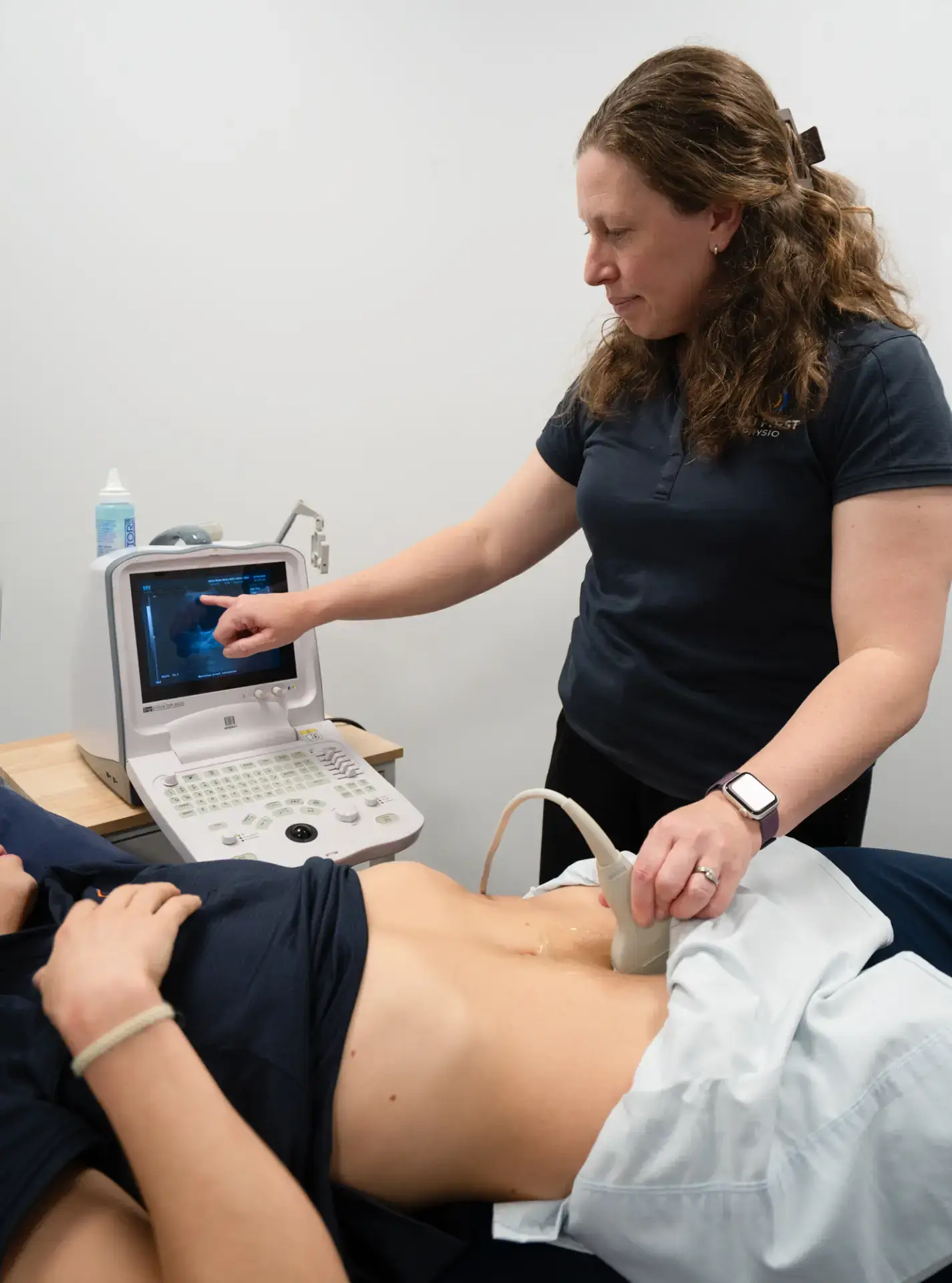
Where clinically appropriate, our team can also perform Point of Care Ultrasound assessment. This is a real-time imaging tool used to observe bladder and pelvic floor function without any discomfort. Pessary fitting is also available where indicated.
After your assessment, your physiotherapist will explain their findings clearly, answer your questions, and work with you to develop a plan that fits your situation and your life.
Highy recommended expert physiotherapy care
The treatment throughout my recovery was outstanding, professional, and always tailored. The support, expertise, and encouragement made a significant difference during a challenging time. Thank you for helping me on the road to recovery — I highly recommend your services to anyone needing expert physiotherapy care.
Carolynn Searell
Helped me regain confidence
I was struggling with continence issues and lack of confidence in social situations. Jess has helped me to regain some confidence through rediscovering my Pelvic floor muscles, and using techniques to retain my body and brain. Jess is supportive, kind and professional in her manner. Approaching a Pelvic floor therapist was a challenge for me, but I was comfortable having Jess as a Therapist, and would happily recommend her.
Wendy
Great individualised exercise programmes
Knowledgeable, efficient and effective physiotherapists at You First. Great individualised exercise programmes as follow up, and there's a gym onsite if required. I definitely recommend them.
Margaret Ingram
$148 (Regular)
$140 (Concession)
$53 (Regular)
$45 (Concession)
$55 (Regular)
$50 (Concession)
$30 (Regular)
$25 (Concession)
$210 (Regular)
$203 (Concession)
$105 (Regular)
$98 (Concession)
*Concession pricing applies to community services card holders and school children
If your concern relates to an accident or injury, ACC may cover part of the cost. Maternal birth injuries sustained from October 2022 onwards are ACC-coverable — we can lodge the claim for you directly, and you do not need a GP referral.
Questions about costs before you book? Call your nearest clinic, we're happy to help.

No. You can book directly — online or by phone — without a GP referral. If you've been referred by a GP, midwife, obstetrician, or specialist, let us know when you book and we'll note it on your file.
Your initial appointment is one hour. It begins with a conversation — your history, your symptoms, what you want to get back to. Depending on what you share, this may be followed by an external physical assessment and, where appropriate and with your explicit consent, an internal examination. Your physiotherapist will explain everything clearly before proceeding and you remain in control throughout.
Not necessarily — and never without your full, informed consent. An internal examination can provide important clinical information in some situations, but it is not always required. You can decline at any point and you will still receive a thorough and helpful assessment. Your physiotherapist will always explain what an examination involves and why it may be helpful before asking your agreement.
Your initial assessment is one hour. Follow-up appointments are 30 minutes. This longer initial appointment reflects the time needed to properly understand your history and what matters to you — you will not feel rushed.
Yes. Pelvic health concerns that have been present for a long time are absolutely something physiotherapy can work with. A longer history doesn't mean the situation can't improve — it often simply means the approach needs to be more carefully tailored to you. That's what the initial assessment is for.
This is one of the most common things we hear. The short answer: if something has been on your mind — even occasionally, even if it feels minor — it's worth getting assessed. You don't need to wait until it's significantly affecting your daily life. If, after your assessment, we don't think physiotherapy is the right fit for your situation, we'll point you toward other health professionals who can help.
Yes. Jess Kydd-Coutts has specific training in male pelvic health and sees male patients for urinary concerns, pelvic pain, bowel issues, and other pelvic health presentations. No referral needed — book directly.
Comfortable, loose clothing is ideal — you may be asked to undress partially during the physical assessment, and you'll be given privacy to do so and kept appropriately draped throughout. You don't need to bring anything specific to your first appointment. If you have any relevant reports (ultrasound, gynaecology letters, etc.), bring those along — useful context, though not essential.

Pelvic Health Physiotherapist
I grew up on the south coast of England in Christchurch (twin town of Christchurch, NZ) before moving to London to train as a physiotherapist, graduating from Brunel University London. I began my career in a leading NHS teaching hospital, where I quickly developed a passion for pelvic health. I went on to lead the Pelvic Health Physiotherapy Team at Imperial College Healthcare NHS Trust before returning to the south coast of England, where I led an NHS pelvic health team. I have experience across both public and private healthcare settings and work with people across all stages of life.
I take a calm, supportive, and evidence-based approach to care, with a strong focus on education and helping people feel confident and informed about their bodies.

Pelvic Health Physiotherapist
As a pelvic health and musculoskeletal physiotherapist, I am passionate about helping women achieve their goals and improve their quality of life. Before becoming a physio, I had a career as a contemporary dancer, teacher, and choreographer, and worked as a personal trainer in New Zealand, London, and Edinburgh. After returning to NZ, I completed my physiotherapy studies at AUT in Auckland and moved home to Christchurch, joining the You First team in 2018.
Since then, I have focused on building my expertise in pelvic health – an incredibly special field of physio. I particularly enjoy working with artistic athletes to rehabilitate and return to competition, and I find it very rewarding to support women through every stage of life, from pregnancy and postnatal recovery to peri- and post-menopausal changes.
Not sure which member of our team is the right fit? Give us a call — we're happy to help.
Call now to book your appointment with Jess or Kate
Riccarton
03 348 5359Longhurst
03 595 0050Health Tips & Updates
